
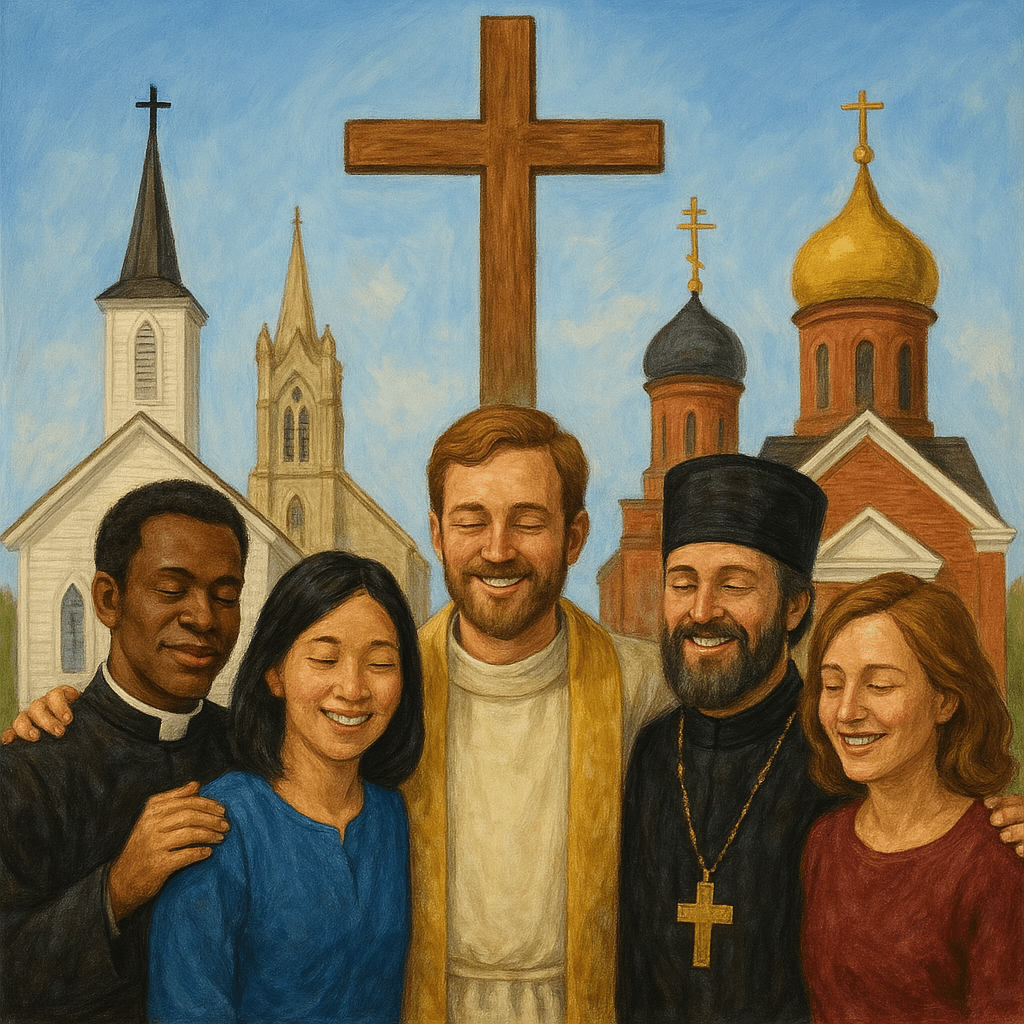
On the eve of His Passion, Jesus gathers with His disciples for the Passover meal. He washes their feet, gives them a new commandment, answers their questions about His departure—and then, He prays.
In the Gospels of Matthew, Mark, and Luke, Jesus prays alone in the Garden of Gethsemane. His disciples are nearby, but asleep. In John’s Gospel, however, the scene is different. Jesus is still at the table. He turns from teaching to interceding—not only for His disciples, but for all who will come to believe through their word.
That includes you and me.
“That they may all be one. As you, Father, are in me and I in you, may they also be in us… so that the world may believe that you have sent me.”
(John 17:21)
This is not a casual request. Jesus’ prayer for unity lies at the very heart of the Church’s mission. He longs for a communion so deep, so intimate, that it reflects the very life of the Trinity: a perfect love among distinct persons, united as one.
And yet, this unity remains incomplete.
The Wounds of Division
The Body of Christ has been wounded by centuries of division. The Great Schism of 1054 split the Catholic and Eastern Orthodox Churches. The Protestant Reformation fractured Western Christianity even further, introducing theological, cultural, and political rifts.
These divisions were not mere historical events. They are deep and enduring. They have shaped our identities, our communities, and our perceptions of one another.
But God is not finished with us.
A Church Reaching for Unity
Guided by the Holy Spirit, the Church continues the work of healing. Our newly elected Pope Leo XIV has made this a clear priority. His papal motto, drawn from St. Augustine, proclaims: “In the one Christ we are one.”
In his installation homily, he called for “a united Church, a sign of unity and communion, which becomes a leaven for a reconciled world.” His actions already reflect this vision: he has met twice with Ecumenical Patriarch Bartholomew and reaffirmed a commitment to the reestablishment of full and visible communion among all who profess faith in the Triune God.
The Catholic Church and the Orthodox Churches share deep roots—apostolic origins, sacramental life, and reverence for the Church Fathers. There is a spiritual kinship here, even as real obstacles remain.
Unity with Protestant communities presents a different set of challenges—given their diversity and lack of centralized leadership. But here, too, progress continues. Bilateral dialogues with Anglicans, Lutherans, Methodists, Reformed Churches, Evangelicals, and Pentecostal groups have borne real fruit.
One notable achievement is the 1999 Joint Declaration on the Doctrine of Justification between the Catholic Church and the Lutheran World Federation. It represents a healing of one of the core theological disputes of the Reformation. Since then, Methodists and Anglicans have affirmed the declaration as well.
Today, Christians across traditions collaborate in promoting religious freedom, humanitarian work, and care for creation. The bonds are growing. But unity is not only the work of popes and theologians.
Unity Begins with You
Jesus prayed for unity. The Church dialogues for unity. But you and I—we must live for unity.
This does not begin in conference rooms or papal visits. It begins in hearts transformed by Christ’s love. It begins with a conversion of heart.
Too often, we hear among Catholics words of judgment, even superiority, toward other Christians—or even toward other Catholics. While we believe the Catholic Church holds the fullness of truth, we must never assume that other communities, or even non-Christians, are without access to truth or grace.
Let Jesus’ prayer echo in your own soul. Make it part of your daily intercession:
“That all Christians may be led by the Spirit of truth and peace.”
Communion, Not Uniformity
Christian unity does not mean sameness. It is not about flattening differences in doctrine, culture, or worship style. Rather, it is about communion—a bond of love and mutual belonging.
Just as the Trinity is three distinct persons united in perfect love, so too the Church is called to reflect that divine harmony. Not by being identical, but by being united in truth, love, and purpose.
Unity honors diversity. It welcomes dialogue. It seeks understanding without compromising conviction. It draws people together in a common identity and mission rooted in Christ.
A Witness to a Fractured World
In a time marked by ideological, racial, political, and cultural division, the visible unity of Christians offers a powerful witness. When we are united—despite our differences—the world sees something radical and hopeful. The Gospel becomes credible. Love becomes visible.
The world needs this witness now more than ever.
So do not settle for division. Do not resign yourself to estrangement. Let Christ’s prayer become your own. Let it shape your heart, your words, your actions:
“That they may all be one, as you, Father, are in me and I am in you… so that the world may believe.”
 Composing Catholic
Thank you, Deacon Alan, great reflection. If only everyone would do what you suggest!
Ann Marie H.
LikeLike