
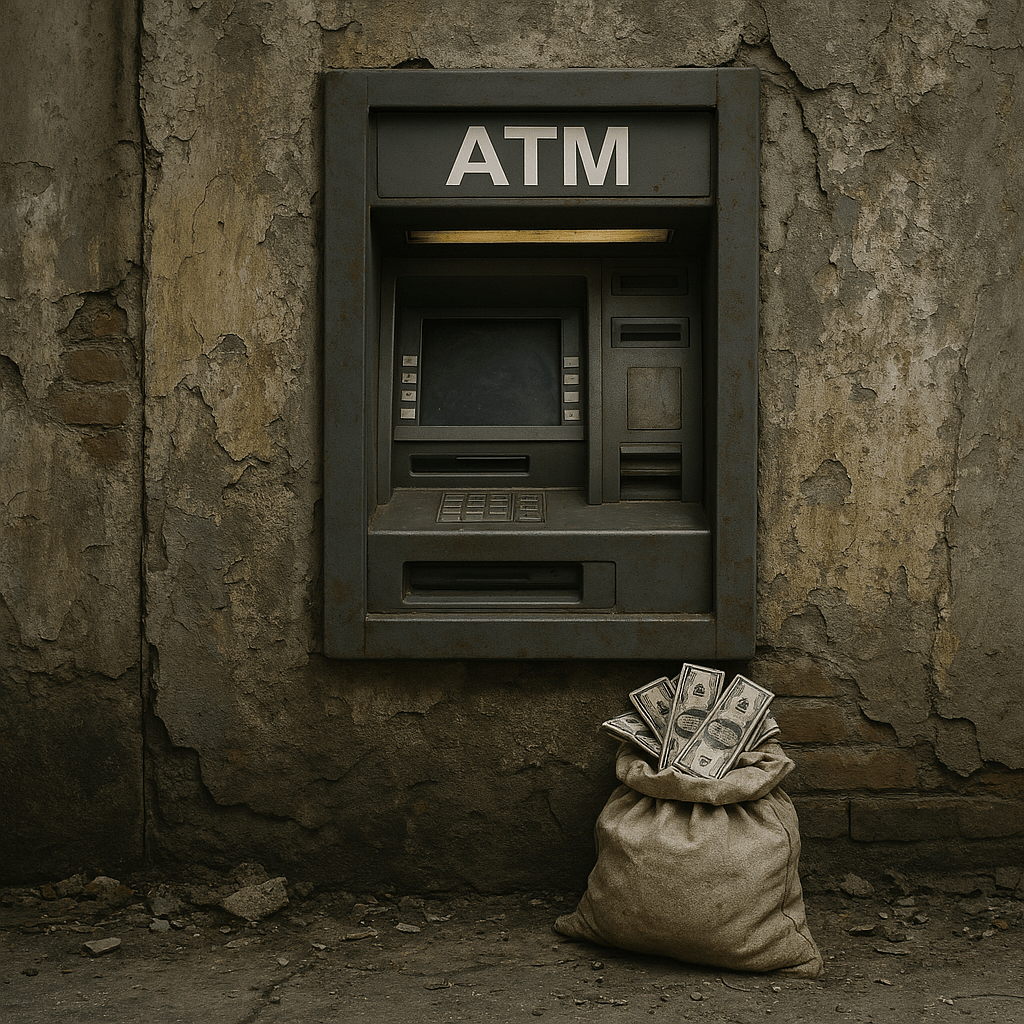
There was a little local bank in the center of the town and in its lobby, a single ATM. In the early days he had broken the back of it open with a crow bar. It was payday that evening, a bi-weekly event. He had his pocket-sized notebook with him that listed all of the hours he’d worked, the type of work he’d done with the corresponding payrate based on the table he’d found at the town hall, and his total. There was no gross or net income anymore, just the total. He received no services so he paid no taxes, Social Security no longer existed and neither did health insurance.
He counted out his money and placed it in his bag. The ATM was flush with cash, he’d recently filled it back up with money from another bank in a surrounding town.
…
The next morning at six sharp, he rose just before his alarm went off. His routine was as much like clockwork as the analog one on his nightstand. A habit formed long ago, in his life before. He stepped into his slippers and put on a robe. It was early September and starting to feel like fall.
Eddie was in the office when he walked past, sitting in his perch set up in the room’s single window and staring out at the quiet street. Hearing him shuffle past, the cat leapt down and bounded after him.
In the kitchen, Eddie purring as he emptied his bowl, he made his own breakfast. The generator, firing away outside, was running low on gas. He’d have to remember to buy some from the gas station soon.
While he ate his eggs and beans, he fiddled with the dials of his ham radio. He often thought about the Dark Forest Hypothesis whenever he used it. Both as an answer to why no one ever answered and maybe why he should stop trying. Not that he ever would.
…
Off to work, and a full day he had ahead of him. The grass on the town common needed mowing and the bushes trimming; part of the library’s roof needed patching; and half the town hall still needed painting. He hadn’t fully appreciated the scale of that particular project when he’d taken it on but he was pleased with the results so far.
He did a great variety of jobs around town, jobs he’d had little experience with before. The jobs were more physical and while he was no longer young he took great pleasure in his work; a kind of pleasure he’d rarely gotten in the decades he’d spent behind a desk.
…
After work, he stopped by the cemetery. Not the town’s old one, but the one he’d made. And filled. Those early weeks and months, when it became clear that no one was coming to help…he had not gotten any pleasure from that work. But he’d understood its importance. Now he visited the cemetery at least once a week, to freshen up the flowers at the graves of his wife and children.
…
The perishables were long since gone from the supermarket, these he had to produce himself, but there was still plenty of boxed and canned goods. Expiration dates for those were never exactly a thing. For a supermarket, there was a decent selection of clothes too. With the kind of work he did, he went through shirts and shoes fast. His cart full, he grabbed a new toy for Eddie because, why not?
There was no room in any of the registers anymore so he’d taken to putting his money in paper bags beneath them. It was important for him to pay for what he took since he hadn’t done the work to produce it. He counted out exactly what he owed and placed his money in one of the bags.
…
Sitting on his front porch after dinner, Eddie curled up on his lap, he sipped a cup of tea and looked up at the stars. There was nothing like a night sky free from light pollution. He wasn’t happy, he never would be again, but he was content for the moment. He still didn’t know for sure what had happened and he definitely didn’t understand why it had to happen. He didn’t truly know if anything actually mattered. But every day he chose to believe that things did.
 Composing Catholic