
She was never right – that’s what they all used to say. Her father, in the few years before he’d left, couldn’t stand, or understand, the way loud noises and bright colors affected her. Then there were her sensitivities to certain textures and, generally, to touch at all. The more of the world she learned, the longer her list of phobias grew. He refused to walk on eggshells in his own home for a child he’d never wanted.
To her teachers, she was a burden. In those crowded classrooms, they were responsible for too much to give such an impossible child the attention she needed. Even the specialists she was pulled out of those classrooms to see knew little of what to do for her.
To her peers, she was an oddity, a freak: someone to avoid and snicker at from a distance.
To the doctors, who could never find the right diagnosis, she was a puzzle they did not want to be challenged to solve. They upped her medications and then tried new medications before, always, passing her along to someone else.
To her mother, she was precious, though deep down, her mother knew her daughter had ruined her life. She had sapped her of everything she’d had to give. And when her mother died, she had no one.
Year after year on the streets, she survived as best as she could while her symptoms grew worse. A shut-in who feared the world, forced out into the cold of it. Her body grew sick and her mind threatened to fracture altogether.
…
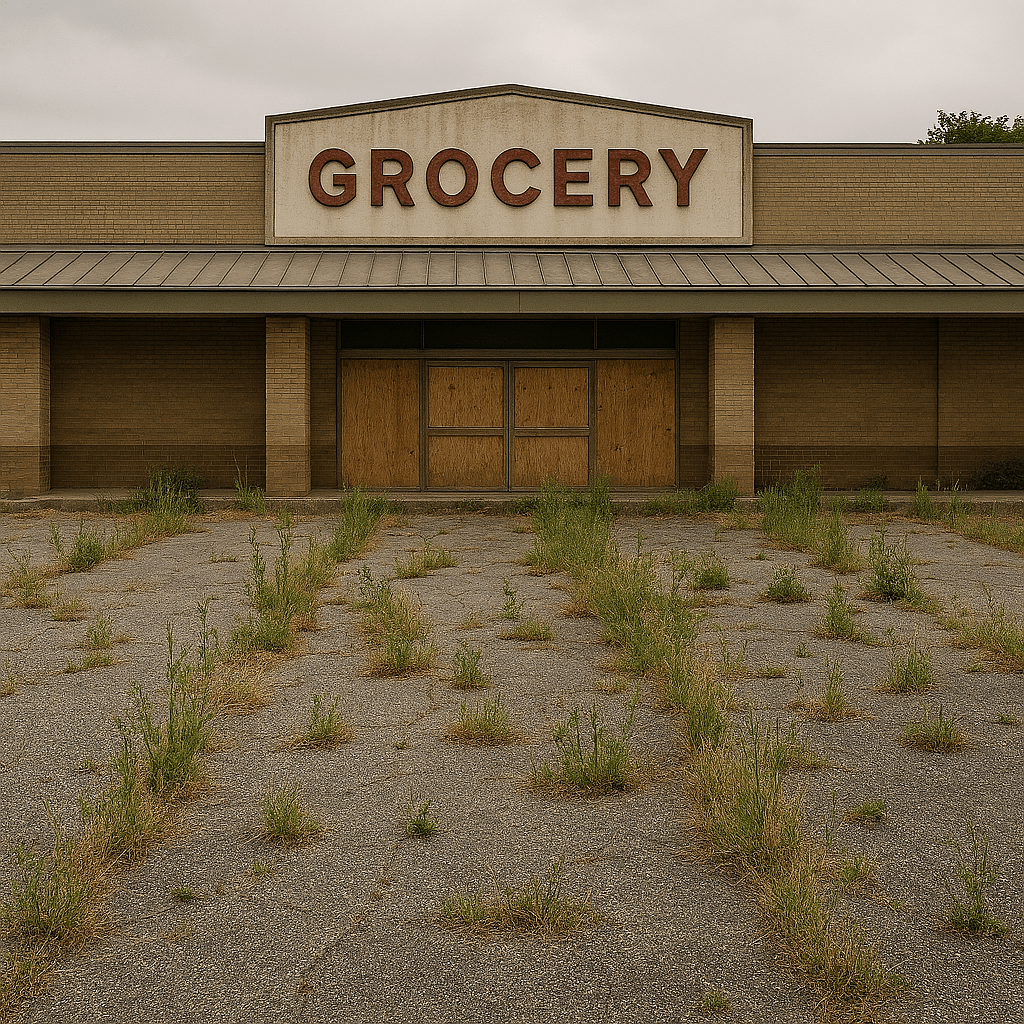
There was a small plaza in the city she hobbled through. It held a shuttered grocery store and a parking lot filled with lines of knee-high weeds growing out of the cracks in the asphalt. It was a forgotten place: there were better, more secluded spots for the local teens to party and, thanks to the city’s zoning laws, redevelopment seemed impossible. She could think of nowhere better to make her home.
She set up her shelter made of water-damaged cardboard and shredded blue tarp under the old store’s front awning and leaned up against the wooden boards that covered the dead automatic doors. When she wasn’t collecting cans to eke out her humble existence, she was huddled under the safety of her shelter.
She knew that decrepit plaza better than anyone but even she might never have discovered the tiny city hidden beneath the tall weeds.
…
Free from the existential threats of human feet and lawnmowers, a unique and wondrous ecosystem developed on a small rectangular median of grass near the center of the lot. The conditions were just right in that place for evolution to proceed rapidly and microscopically. Over the years, plants and animals – so small they may as well have been invisible – came and went. Complexities grew and grew until, finally, one organism gained sentience.
These intelligent beings multiplied and explored; formed tribes, nations, kingdoms and then great empires that together spanned the whole length and width of the median. Having evolved under the shade of the tall grass, they could not tolerate the heat of the exposed pavement beyond. And so, having conquered the limits of their world, they set about trying to conquer each other. Wars were fought, wars that grew more terrible as their technological capabilities advanced. Wars that spanned centuries under their timescales.
Finally, when they had nearly obliterated themselves, when they had reduced the grassy median to a wasteland, the survivors united together. From the dust and ruins rose their great city, what was to them a seemingly infinite metropolis. A city of innumerable towers that reached to staggering heights, a city of vibrant culture, a city of unfathomable technology.
They sent probes out into the great, burning beyond. Further and further they went. Through all the time that followed, they learned of their unique and vulnerable circumstances. They learned of the wider world and all of the giants that might destroy what they now understood as their tiny, but still great, city. The faded legends of the flattening world killers now made sense. Terribly so. They would have close calls, mainly involving birds and squirrels, crises averted by sheer luck. They set about forming plans for their protection.
…
As she’d always been sensitive, painfully so, she could feel them calling her towards them when most others would not have. It was a feeling she had, an imperative. Something she just had to do. She rose from where she sat under her shelter and limped across the parking lot.
…
They had studied her for generations before they set the might of their industry to produce exactly what she needed. Up the impossibly immense structure went while their scientists got down to work. Builders and scientists together would spend their entire careers at their tasks before passing the jobs on upon their retirement.
…
Beneath the protective cover of tall grass, she saw the city. The planes flying through the air, the cars on the roads and the trains on the tracks were too small for her to see but she could see the towers. Towers mere millimeters in height, separated by wide city streets that were even more narrow than the line of a pencil.
Though tiny in scale, the city was breathtaking. And it just kept going and going…It was the most beautiful thing she had ever seen.
Then she saw the metallic spear at the center edge of the median. At the size and width of a baseball it dwarfed the buildings around it. As she gazed at it, the sphere opened like a flower and a glass bottle the size of a thimble rose up from its center.
She felt the same feeling, the imperative again, only this time it told her to drink it. With just a bit of apprehension, she did. When she finished, she complied again and placed the bottle back down in its spot within the opened sphere. Down the bottle sank as the sphere closed.
…
She had never felt better. With each dose of medicine from the sphere her anxiety faded a bit more, her mind became clearer and her body steadily healed from the ailments it had acquired from such a long life on the streets.
Theirs was a symbiotic relationship: she didn’t know who lived in the city, but she knew it was her job to protect them. And she did. From wildlife and storms, and especially from threats of redevelopment. Her crafty mind, now freed, thought of plenty of ways to gum up those works.
Before long, what began as a mere exchange – medication for protection – grew into something far deeper. She, who had never felt capable of anything, was finally needed, worthy, and beloved by the billions in the city.
…
For years now, she has done her job and she has done it well. Her job, it can be argued, is the most important work in human history. This is because, eventually, so many millennia in their scale later, the city’s inhabitants imagine they will grow powerful enough to protect themselves. At which point, they plan on sharing all of their world-changing discoveries with the planet’s only other sentient species.
So, tread lightly. Who knows what wonders we have already trampled beneath our feet.
 Composing Catholic