
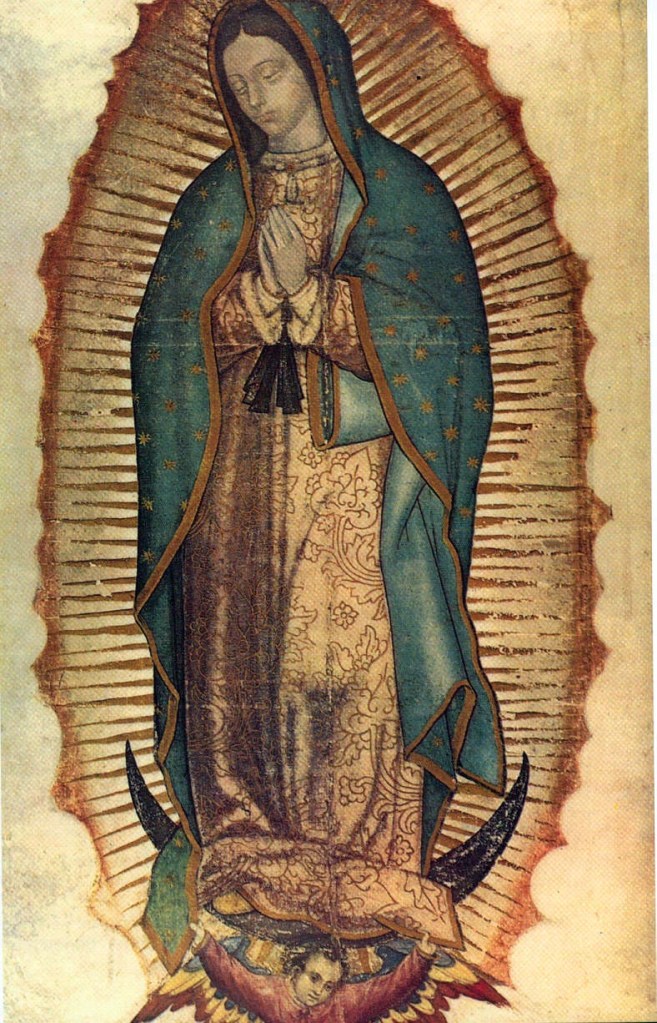
On October 12, 1492, Columbus landed in what we now call the Bahamas. Less than 40 years later, on December 9, 1531, when Juan Diego, an indigenous Aztec, was on his way to morning Mass, the Blessed Mother appeared to him on Tepeyac Hill, at the outskirts of what is now Mexico City. She asked him to go to the Bishop and to request in her name that a shrine be built where she promised to pour out her grace upon those who invoked her. The Bishop, who did not believe Juan Diego, asked for a sign to prove that the apparition was true. On December 12, he returned to Tepeyac. Here, the Blessed Mother, calling him Juancito, told him to climb the hill and to pick the flowers that he would find in bloom. He obeyed, and although it was wintertime, he found roses flowering. He gathered the flowers and took them to Our Lady who carefully placed them in his mantle and told him to take them to the Bishop as the “proof”. When he got there and opened it, the flowers fell on the ground and there remained on his blanket (or “tilma”) and created what is known as the apparition at Tepeyac.
The miraculous image, which is preserved in the Basilica of Our Lady of Guadalupe, shows her with Aztec features and noble dress. She is supported by an angel whose wings look like one of the major gods of the traditional religion of that area. The moon is beneath her feet and her blue mantle is covered with gold stars. The black garment about her waist signifies that she is pregnant. The image depicts the reality that Christ is “born” to all people including in the “New World,” a message as relevant to this “New World” today as it was 500 years ago.
It is a painting on loosely-woven cactus fibers that survives intact to this day.
When Pope John Paul II celebrated Mass at the basilica built in 1999, he spoke these words: “Brothers and sisters, the time has come to banish once and for all from the continent every attack against life. No more violence, terrorism, and drug-trafficking! No more torture or other forms of abuse! There must be an end to the unnecessary recourse to the death penalty! No more exploitation of the weak, racial discrimination or ghettoes of poverty! Never again! These are intolerable evils which cry out to heaven and call Christians to a different way of living, to a social commitment more in keeping with their faith. We must rouse the consciences of men and women with the Gospel, in order to highlight their sublime vocation as children of God. This will inspire them to build a better America. As a matter of urgency, we must stir up a new springtime of holiness on the continent so that action and contemplation will go hand in hand.”
Pope Benedict XVI, in a homily on this day in 2011, said: “The venerated image of the of the Black Madonna of Tepeyac, with her sweet and peaceful countenance, imprinted on the tilma of the indio St Juan Diego, shows her as “the ever Virgin Mary, Mother of the True God from whom she lives.” She reminds us of the “woman clothed with the sun, with the moon under her feet, and on her head a crown of twelve stars; she was with child.” (Rev 12:1-2). She signals the presence of the Savior to the indigenous people. She always leads us to her divine Son, who is revealed as the foundation of the dignity of every human being, as a love that is stronger than the powers of evil and death, and the fountain of joy, filial trust, consolation, and hope.
Pope Francis, in his 2016 homily at the Basilica in Mexico, recalled what Mary said to Juan Diego: “’Am I not your mother? Am I not here? Do not let trials and pains overwhelm you.’ She tells the same to us,” he said, ”as she did Juancito, today, she comes to tell us again: be my ambassador, the one I send to build many new shrines, accompany many lives, wipe away many tears. Simply be my ambassador by walking along the paths of your neighborhood, of your community, of your parish; we can build shrines by sharing the joy of knowing that we are not alone, that Mary accompanies us.”
Let us pray that minimally in our day-to-day encounters, we may proclaim this message of hope.

